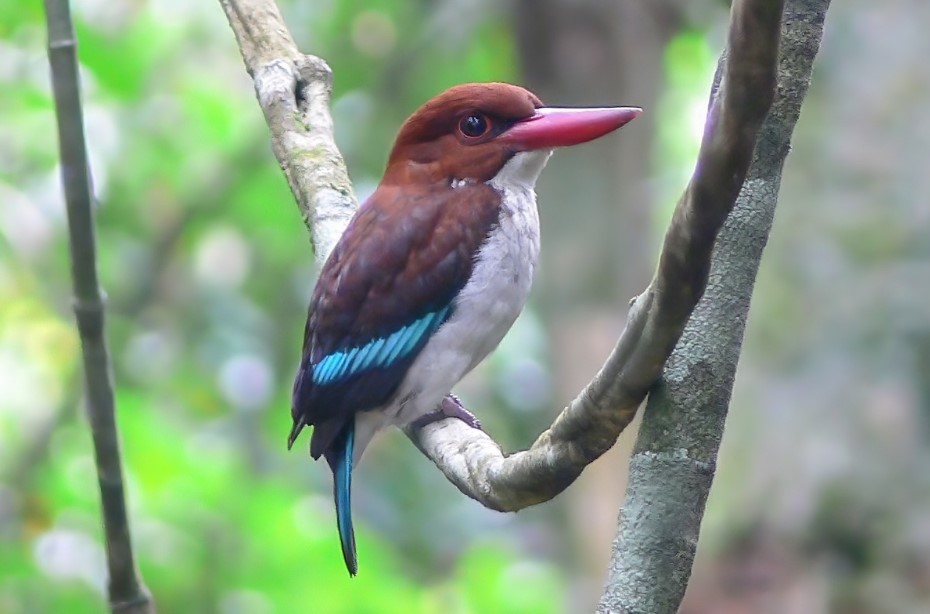
The Chocolate-backed Kingfisher
Budongo Forest is home to this amazing kind of bird, especially in the Royal Mile and Forests. Because of its striking colouring, unusual eating habits, and rainforest environment, the Chocolate-backed Kingfisher (Halcyon badia) got its name. It is the largest natural tropical rainforest in Uganda, so if you ever find yourself in the African rainforests, make sure to look for this lovely bird. The ecosystems that encircle rich woodlands, including riverbanks, woodland clearings, thickets, and wildlife-supporting riverine environments, are home to this amazing bird.
Appearance of the Chocolate-backed Kingfisher
This striking forest kingfisher has brightly coloured wings, a butt, and a bright red bill. Both the top and the underpants are dark chocolate. Both sexes have a similar immature look, with brownish-grey scaling on the upper breast and flanks and a bill with a blackish-red tip.
Vocalization
Regarding the calls, even when the Chocolate-backed Kingfisher is hidden, birders may more easily identify it due to its remarkable vocalisation range patterns. The characteristic loud series, wi-wi-wi-wi-wi-wi-wi-wi-wi-wi-wi-wi-wi-wi-wi-wi-wi-wi-wi-wi-wi-wu-wu-wu-wu, starts high in the canopy and ends with single notes that rise, decrease, and eventually fade away. It is quite melodic and melancholic, with long intervals between each series.
Diet of the Chocolate-backed Kingfisher
These Kingfishers spend most of their time silently watching clearings from their position high in the treetops. From their perches, they either soar to seize prey in the air or descend to hunt it on the ground. Chocolate-backed Kingfishers have been seen to assault columns of driving ants and eat the insects the ants drive out or the ants themselves. Invertebrates, grasshoppers, beetles, and small lizards are their main food sources. The Chocolate-backed Kingfisher, a proficient angler, is distinguished by its keen vision and beak. It is often seen waiting to catch its prey while perched on a branch near the water’s edge.
Distribution
The Chocolate-backed Kingfisher (Halcyon badia), a ventriloquial forest kingfisher, is found around the world, but it is most common in sub-Saharan Africa. This amazing bird, which belongs to the Halcyoninae subfamily, lives along Uganda’s breathtaking Budongo Forest’s Royal Mile, or Busingiro. They are rare, local, and always move in couples in the high canopy of dense woods at an elevation of 700–1400 metres in western Uganda.
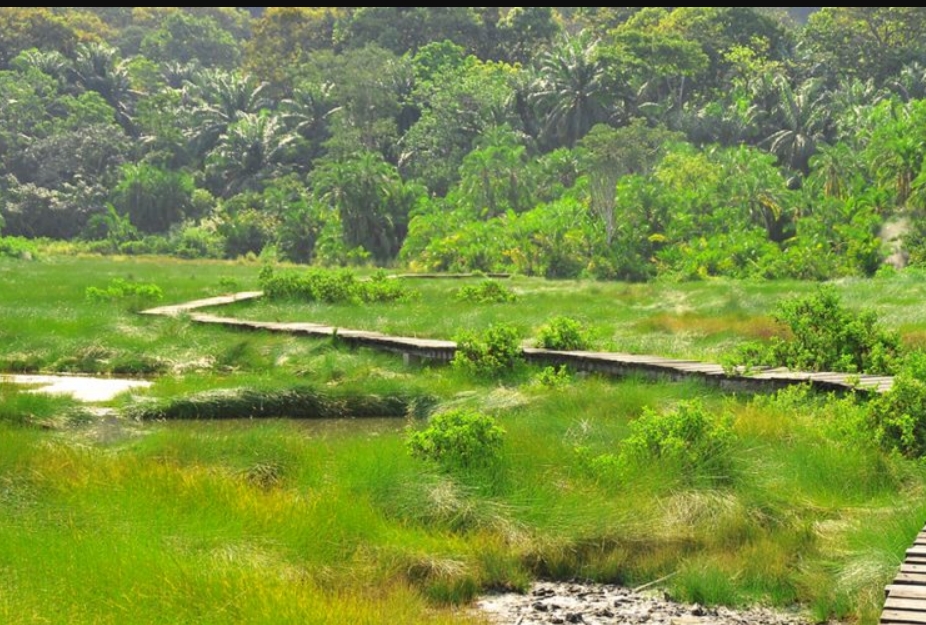
Budongo Forest – Royal Mile and Busingiro tourism sector
Tucked deep beneath Budongo Forest is the opulent Royal Mile and Busingiro tourism sector. This unknown gem of Uganda is a birdwatcher’s paradise, with nearly 360 species of birds currently recognised. Among the unique and uncommon species that inhabit this area are the captivating Uganda Woodland Warbler, the breathtaking Lemon-bellied Crombec, and the magnificent Chocolate-backed Kingfisher.
You will be amazed to spot some rare bird species, including the striking Ituri Batis, Red-fronted Antpecker and Nahan’s Partridge, and Ituri Batis. On a lucky day, you may also come across the tiny African Dwarf Kingfisher that is endemic to the area. Other species to see include the Dusky Long-tailed Cuckoo, Green and Tit Hylia, Brown Bald Eagle, Forest Robin, Fire-crested Alethe, Scaly-breasted Eagle, Grey and Yellow Longbill, among others.
Threats of the Chocolate-backed Kingfisher
Climate change
One of the main factors influencing the spread of the Chocolate-backed Kingfisher species is climate change, which has a detrimental impact on the locations of these species, the distribution of their habitats, and the characteristics of their prey. Climate change influences the ecology of these thick tropical rainforests, particularly in terms of variation in temperatures. During dry seasons, there is a scarcity of some living organisms, such as insects, snails, and others, which these birds can feed on as a result of high temperatures, and vice versa.
Human Activities
Due to man’s day-to-day activities, such as grading the landscape through daily constructions in birdlife locations, several bird species lose their natural habitats and embark on looking for shelter elsewhere, which may not be possible. Such activities have tremendously degraded the environment, leading to total habitat loss.
Man’s activities include settlement, industrialisation, road construction, and farming, among others. Industries omit chemicals with toxins that are dumped in wetlands, which are breeding places for birdlife. This chemical pollution has a negative impact on some of the breeding bird areas, threatening their population.
Prey availability
Since fish are mostly preyed upon by swiftly moving water, flooding brought on by severe rains can disperse them. In muddy, cloudy water, the Chocolate-backed Kingfisher has a difficult time locating and catching prey. This problem becomes crucial while they are feeding their young.
Conservation
The Chocolate-backed Kingfisher reside in tropical rainforests and around riverine forests that need to be protected. However, deforestation has proved to be one of the main factors that threaten their survival. Therefore, the protection and restoration of these bird habitats within their range can positively impact a change in providing good nesting and foraging habitats.