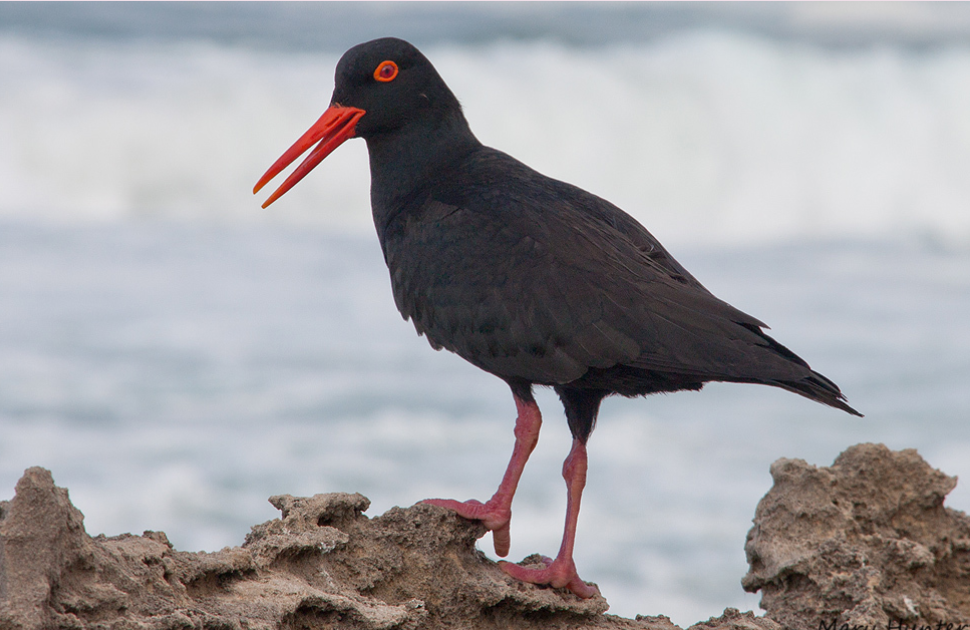
The African Black Oystercatcher
The African black oystercatcher is a large wader found along southern Africa’s coasts and islands. Its population ranges from 6,000 to 10,000, breeding from November to April. The name honors naturalist Alfred Moquin-Tandon, who discovered and named this bird species before Bonaparte.
These rare birds have black bodies, red bills, and legs. They are vulnerable but visit South Africa, Namibia, and the coastal areas. Since the beach driving ban, their numbers have increased along the eastern and southern Cape coast. More still, they are sea birds and are mainly found along coastal islands, estuaries, and lagoons.
Habitat
The African black Oystercatcher is found along the coasts and islands of Southern Africa, breeding from Namibia to South Africa. There are over 6,000 adults, with one historical vagrant record from Gambia identified as H. moquini. These beautiful birds are common on Eastern Cape beaches, especially near rocky areas.
They feed on mussels and limpets at low tide using their chisel-shaped beaks. They breed in the summer above the high tide zone, with chicks that blend into the sand. Removing beach driving permits has improved egg and chick survival. Their sightings and piercing calls are evocative and memorable.
Breeding
Breeding is more successful on offshore islands with fewer predators. Therefore, birds create small dents in the sand to lay 1 to 4 eggs, which they cover with materials like broken shells for camouflage. Eggs take 28 days to hatch, and chicks cannot fly for the first 45 days, and these eggs may reach an average of 65 mm in length.
Their diet consists mainly of marine life, focusing on invertebrates like worms, crabs, mussels, and limpets, using their strong beaks to open shells during low tide. Limpets are those shells/snails that often get stuck on coastal rocks.
Merely seeing them, you would think they feed on oysters, as they have it in their name, but instead, they rarely eat those. They use their longish, strong beak to open the shells, and they feed during low tide.
Characteristics
The African black oystercatcher is a large bird with all-black feathers, red legs, and a broad red bill. Males and females look alike, but females are bigger with a longer beak compared to the males. Juveniles are grey and lack the bright colours of red until the time of fledging. Their call is loud and similar to Eurasian oystercatchers. This is a migratory bird species and a vagrant species in South Africa; its white and black plumage causes confusion.
Feeding
African oystercatchers mainly prey on molluscs like mussels and limpets but also consume polychaetes, insects, and sometimes fish. They can pry open mussels and find food in sand.
Life Span
The African black oystercatcher lives about 35 years and pairs for 25 years. Most mainland egg and chick deaths result from human disturbance and avian predation, with starvation affecting offshore chicks.
Conservation Status
As of December 2017, the African oystercatcher is classified as “Least Concern” by the IUCN, with an upward population trend due to community conservation efforts. South Africa has also downlisted it to Least Concern.