Experiential Lion Tracking In Queen Elizabeth National Park
Experiential lion tracking in Queen Elizabeth National Park is one of the top activities that attracts tourists to the park. This experience involves following individual lions or groups of lions to closely observe their behaviors, all under the guidance of researchers from the Uganda Carnivore Program (UCP). They use the radiation trackers to monitor the movement of lions with a radio collar. This program was initiated in the 1990s as part of the Uganda Large Predator Project, driven by concerns that an epidemic, specifically the canine distemper virus, could spread from Serengeti National Park and threaten predator populations in Uganda. Research revealed that many lions were dying due to poisoning. In response, the program focused on monitoring the lions in the park and raising community awareness about the conservation of predators.
Cost of Lion Tracking Permit in Queen Elizabeth National Park.
Lion tracking in Queen Elizabeth National Park is conducted by the Uganda Carnivore Program in collaboration with the Uganda Wildlife Authority, which manages the sale of lion tracking permits. We recommend that anyone interested in this experience book their permits early, as they are limited and available on a first-come, first-served basis due to conservation practices for lions. The permit costs $210 for non-foreign residents, $160 for foreign residents, and 200,000 UGX for East African Community (EAC) residents. Approximately $10 of each fee goes to the Uganda Carnivore Program, which oversees lion tracking efforts. Lion tracking is done twice a day, in the morning and in the evening. You can make reservations through authorized travel companies like Caracal Explorers .
Lion Tracking In Queen Elizabeth National Park
How is Lion Tracking done in Queen Elizabeth National Park.
Lion tracking in the park is an incredible experience for those who want to get close to lions and learn more about their behavior. This activity takes place in the Kayasenyi plains, located in the northern sector of the park, which is home to the highest number of lions. The experiential lion tracking begins with a briefing on the do’s and don’ts of tracking lions in the park. Days before the activity, game rangers track the lions using the Uganda Carnivore Program (UCP) methods. Typically, they choose dominant lionesses, as these females tend to stay with their group. Male lions often leave the group to mark their territories, being the kings of the jungle.
To study the lions in their natural habitat, researchers sedate them and attach GPS radio collars for tracking purposes. Guided by these GPS devices, researchers and armed game rangers lead participants to locate the lions. During the tracking, you are allowed to go off the main trails in search of them. Once the lions are located, the guides will turn off the vehicle engines and provide insights into the lions’ behavior, including how to distinguish between males and females, their feeding habits, their life span and their tendency to sleep for up to 22 hours a day when content. They will also explain how lions mark their territories and much more.
On good days, you may even witness researchers taking blood samples from the lions. The lion tracking experience in Queen Elizabeth National Park offers an intimate encounter with these magnificent animals and is a must-do activity for any lion lover.
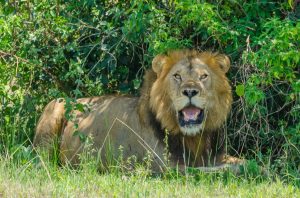
Lion In Queen Elizabeth National Park
Why is Experiential Lion Tracking Limited to a Few People.
Experiential lion tracking in Queen Elizabeth National Park is limited to a small number of participants because this is not just a typical game drive; it focuses on researching lions. A smaller group allows for more intimate and focused experiences, enabling participants to observe the lions’ behavior closely, learn more about them, and take better photographs.
To avoid stressing the lions, as they are not accustomed to human interaction, it is crucial to protect their ecosystem. Increased human disturbance could lead to a decline in their populations. Therefore, to understand the lions’ habits and behaviors effectively, researchers only allow a limited number of participants to join the lion tracking experience and also to keep the nature conserved.
Best Time to Visit Queen Elizabeth National Park for Lion Tracking.
The park is open for lion tracking year-round, but the best times to visit are from June to September and December to February. During these months, there is little to no rainfall, resulting in short grass that makes it easier to spot lions and dry tracks. You can also visit the park from March to May and October to November when rainfall occurs, but the tracks can still be dry. These months are more favorable for budget travelers, as accommodations often offer discounts.