The Elegant Secretary Bird
One of Africa’s most recognisable predators, the Elegant secretary bird (Sagittarius serpentarius) is distinguished by its long, stilt-like legs, pointed crest feathers, and formidable terrestrial hunting technique. Originating from the broad grasslands and savannas of sub-Saharan Africa, this graceful raptor defies convention by hunting on foot instead of by flying. A tall, crane-like raptor with long legs and a striking quill-like plume on its head, as well as bright-red skin on its face. The long spatulate tail feathers, diamond-shaped tail, and dark edge on the hind wing make it easily identifiable when in flight. It favours savanna and wide rangeland, where it uses its strong legs to bludgeon insects, small mammals, and reptiles as it stalks around. is frequently observed in Kidepo Valley National Park in Uganda and Piane Upe Wildlife Reserve.
Description
The monotypic Elegant secretary bird in Uganda is a huge and distinctive raptor, standing 1.2 m tall on long pink legs, with a wingspan of approximately 2 m and a length of 125-150 cm from bill to tail tip. The long black erectile nape feathers, white upper tail coverts, and contrasting black remiges, rump, lower belly, rear flanks, and “shorts” make up the pale blue-grey above and greyish-white below plumage. Along with the comparatively long extended neck, the graded grey tail’s substantially longer center tail feathers and broad black subterminal band with white terminal tips provide a unique flight silhouette.
In the hooked blue-grey bill, the iris is brown, and the naked yellow-orange to orange-red face blends into the blue-grey or yellow cere. The legs’ scales are heavier, purposely for protection especially when intercepting its prey. Though females are slightly larger and less blue-tinged, adults seem comparable. Juveniles are distinguished by their shorter crest and tail, black bill, grey eyes, yellower face, and grey barring on white underwing and undertail coverts.
Behavior- The Elegant Secretary Bird in Uganda
The majority of elegant secretary birds are migratory, spending the majority of the day roaming up to 20 km (12.43 miles) in pursuit of prey. They often hunt alone and in couples or family groups that are somewhat separated. 86% of their diet consists of insects, freshwater crabs, including small rodents, mongooses, shrews, hedgehogs, squirrels, meerkats, small birds, frogs, tortoises, lizards, and snakes, including the deadliest venomous snakes such as puff adders and cobras. They immobilise their prey by stamping and kicking with their feet before using their beak to pick it up; larger prey is initially torn apart, while smaller prey is consumed intact.
Secretary elegant birds frequently utilise rising thermals to soar as high as 3,800 m during the hottest part of the day in order to cool down or relocate to a different location within their territory, which can vary in size from 20 to 70 km2, depending on the habitat. In the late afternoon, partners head back to their previous nest or tree canopy roost.
Although breeding can take place at any time of year, it is usually timed to allow chicks to fledge when food is most abundant, which is during the wet season. The courtship ritual consists of swooping down with closed wings, halting, and then opening again to regain height, as well as undulating aerial displays high above the nest area. The enormous, flattened stick nest, which is 1-2.5 m broad and 30-50 cm deep and is lined with grass, small sticks, wool, animal feces, and leaves, is constructed by both sexes and is located 3-7.5 m high in the trampled canopy of a prickly tree, such an acacia. The first egg is laid, and the incubation period, which lasts 42–46 days, is shared by both parents.
Both parents feed the chicks, and they stay reliant on them until they are 65–106 days old. Around two weeks after leaving the nest, fledglings are able to capture their own prey, and four to eight weeks later, they accompany their parents on foraging excursions.
Habitat- The Elegant Secretary Bird
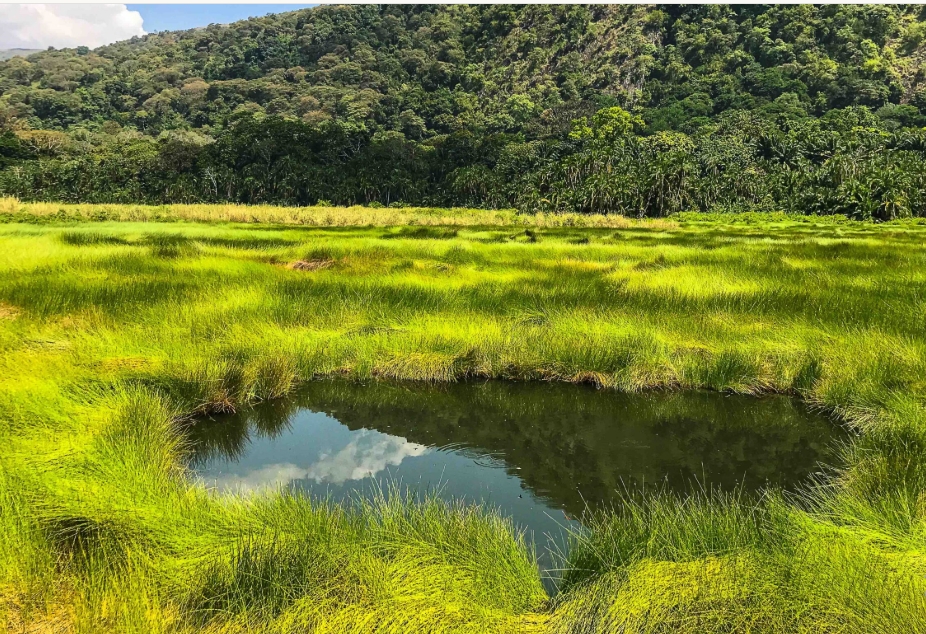
The Secretary bird can be found in open grasslands and savannas, ranging from sea level to 3,000 metres, where there are sporadic acacia trees and the grass is less than 50 centimetres high. These areas include dry steppes, moist grasslands, sparsely wooded savannas, large-scale cereal farmland, and sub-desert. From southwestern Somalia in the east to southern Mauritania in the west, this species can be found all over sub-Saharan Africa. It also spreads southward via East Africa to southern Central Africa and Southern Africa. The Congo Basin and a large portion of West Africa are devoid of this species.
Threats and Conservation
Although widespread and locally common in some areas, this species appears to be declining rapidly in parts of its range. Therefore, the elegant secretary bird is listed as endangered on the IUCN Red List. Threats include habitat loss and degradation due to afforestation of grasslands, land conversion, overgrazing by livestock, and encroaching woody vegetation onto grasslands in South Africa. Other threats include increasing droughts due to climate change, reduced prey availability from excessive burning of grasslands, hunting, increased nest-raiding by humans, capture for the illegal wildlife trade, poisoning from pesticides, and collisions with fences and power cables.
Conservation measures include increasing protected areas within this species’ range, working with landowners to manage properties sustainably for this species, raising awareness of the threats amongst local people, and combating capture and trade.
Despite its graceful stride, the elegant secretary bird in Uganda is a formidable predator. It’s renowned for its lightning-fast, bone-crushing kicks, which it uses with pinpoint accuracy to stun or kill snakes, rodents, and other small animals. This unique hunting method not only showcases its strength and precision, but also plays a critical ecological role in controlling venomous snake populations across the African plains.