Facts about the Secretary Bird
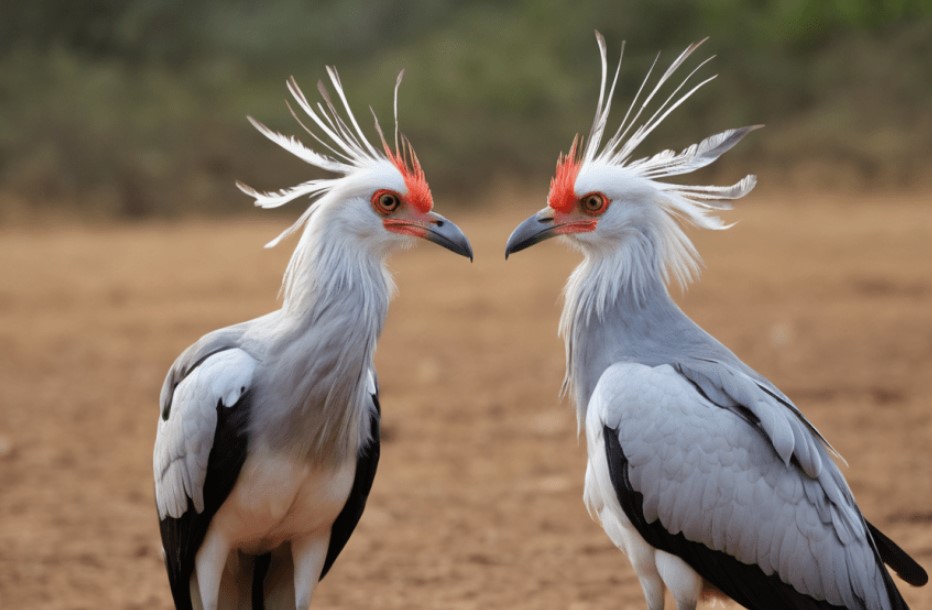
Facts about the Secretary Bird, according to research, this distinct raptor, “the secretary bird,” derives its name from the Europeans in the early 19th century, between 1800 and 1900, a period that witnessed significant change worldwide. During this period, people, especially the male secretaries, wore grey tail coats, knee-length pants in the form of a suit, with quill pens to take notes or during dictations. Oftentimes, these secretaries would put or keep their quill pens behind their ears until the quills were needed again. Likewise, this beautiful secretary bird has long grey wings and tail feathers with similarly dark feathers at the back of the head.
Similarly to that, this majestic raptor appears to be dressed in a tailcoat suit and knee-length pants, with black feathers that run halfway down its legs. This serial predator primarily feeds on snakes and is commonly known as “the archer of snakes”, particularly in the classic savannah grasslands of sub-Saharan Africa. It is closely related to raptors like vultures, kites, and buzzards. Despite spending much of their time on land, searching for prey and forage on foot, the secretary birds are excellent fliers and construct their nests mainly in acacia-related trees, where they lay eggs following the breeding season.
Life span
Secretary birds living in the wild have an average life span of 10-15 years compared to those bird species living in more protected areas, such as zoos and sanctuaries, that can live up to 19 years. This is because of the harsh climatic conditions in the wilderness, such as heavy storms that may lead to severe illness, and long dry periods, which lead to food scarcity, and this leads to starvation and eventually death.
Breeding- Facts about the Secretary Bird
Since these bird species are monogamous, they usually mate with a single partner throughout their entire life. They are territorial, especially when hunting, taking control of over 20 square miles. They always construct their nests high up in thorny acacia-related trees for the safety of their chicks against other predators. Their breeding season occurs mainly between March and August, and they can mate throughout the entire year, mainly on land and at times in trees.
When constructing their nests, they always use and make a tapestry of sticks to form the outline, about 3-5 feet wide and 15- 20 inches deep. A hollow is formed in the middle, where smooth grass is laid and lined to support the eggs during laying and hatching.
They always lay 2- 3 eggs, where both the male and female are responsible for the incubation period that lasts between 6-7 weeks. After hatching, both parents are equally responsible for taking care of these chicks, such as feeding and protecting them from predators. As they search for food, one of the bird species remains behind at the nest, protecting for about 3 weeks against predators like vultures, owls, Hornbills, and Hungry crows, which may take advantage of preying on chicks.
However, based on conducive climatic conditions, with plenty of food, chicks will always survive, and during heavy dry seasons where food is scarce, chicks may not survive due to starvation.
Unique Physical Characteristics- Facts about the Secretary Bird
Its height is quite amazing, ranging between 4.2 and 5 feet, 125cm – 150cm from the bill to the wedge-shaped tail, with a wing of 6.9 feet, approximately 2 meters. With its featherless red-orange face, the species’ upper parts have a pale blue-grey and grey white below, a flattened dark crest, with different dark quills and black flight feathers covering the underparts and extending down to its thighs to the knee joints. Considering all birds of prey, this raptor has the longest legs and is powerful enough to keep it over the vegetation, offering it an incredible viewpoint when hunting its prey. It has thick scales that cover two-thirds of its legs against snake bites while on land.
The taxonomic name of this snake hunter, Sagittarius serpentarius, which means “the archer of snakes”, is worth its name. These bird species use their strong legs to land fatal kicks to a snake’s head before snatching it as prey. Their fatal kicks double their weight and are swift enough, taking about 0.015 seconds to strike their prey. This means that the kick is about 100 times faster than a snake can bite, granting this snake archer an obvious winner.
Hunting Techniques and Diet
These bird species always leave their nests in the morning hours to go hunting. In the mid-morning scorching sun, they always take breaks under tree shades before they resume hunting. During hunting, they tend to distract their prey, especially snakes, by flapping their wings as a target for the venom and then deliver their deadly kicks. They tend to take control of their hunting territories, about 20 square kilometres, during the day. As they wind up their day, before sunset, they return to their nests for the night.
Cultural Significance and Conservation Status-Facts about the Secretary Bird
This bird species is a symbol of protection and resilience in many cultures, especially on the African continent. This is based on the bird’s lethal techniques of snatching and hunting snakes, hence its taxonomic name “the archer of snakes”. Therefore, birdwatchers visiting Uganda shouldn’t miss out on this top highlight. However, its major threat is habitat loss resulting from man’s activities such as agriculture, settlement, and construction, among others. Additionally, the International Union for Conservation of Nature (IUCN) lists this species as vulnerable, meaning there is a need for more conservation efforts to preserve its habitats as well.