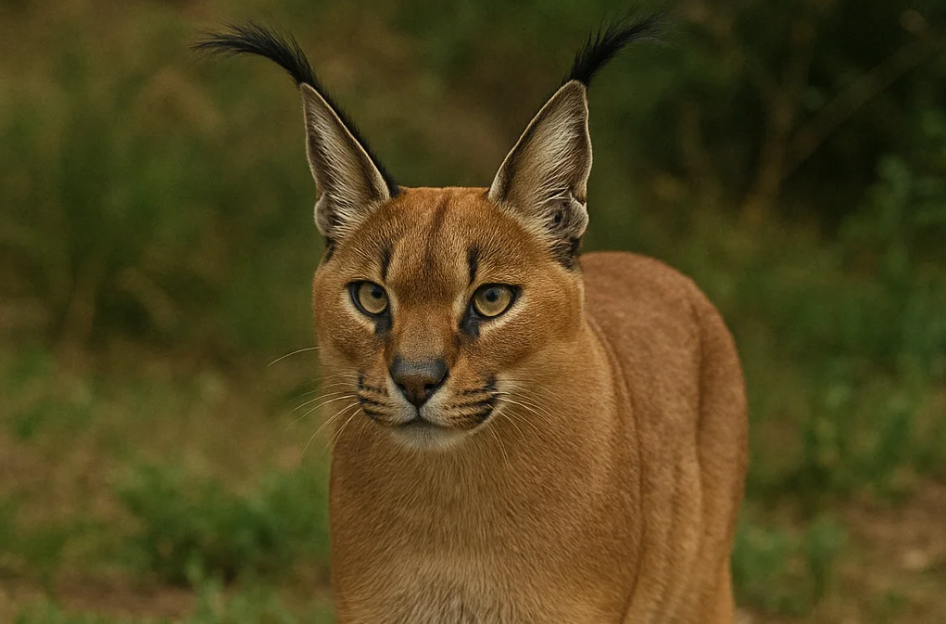
Why Do Caracals Have Black Ear Tufts
Why Do Caracals Have Black Ear Tufts: Even though this wild cat looks like one, the caracal is not a true lynx; it’s its own species, known for those unique black-tufted ears that act as radar sensors. It gets its name from the Turkish phrase “Kara Kula”, which means “black ear”, a direct nod to the sharp, upright tufts that make it instantly recognisable. Despite their small size compared to big cats, caracals are fearless and known to fight off small predators like jackals or defend kills much larger than themselves.
This cat is built for speed, stealth, and precision, and it is one of the unique predators that can snatch its prey, such as birds, out of the sky mid-flight. This is attributed to their swiftness and agility; some have been trained historically in Persia and India for bird hunting, such as flamingos, falcons, and others.
However, many people think that its claws are the deadliest among other parts of the body, but its weapon isn’t its claws; instead, its hiding in its ears. Meet the caracal, the silent hunter that mainly inhabits parts of Africa, Asia, and the Middle East, adapting easily to deserts, savannahs, and grasslands. They are known for those long, mysterious black ear tufts.
Their ears are not for mere outlook; they are highly sensitive and can work independently to pick up the slightest sounds and movements, which is crucial for stalking their prey, especially in the wild. During the time of launching its strike, its powerful hind legs launch it into the air with such formidable force that it can catch birds mid-flight, and sometimes more than one in a single leap or launch.
Why Do Caracals Have Black Ear Tufts: At first glance, these ear tufts look decorative, almost like an antenna, but these tufts may help to amplify sound, guiding even the faintest movement and sounds of prey through the grass, such as rodents, small antelopes, mice, and others.
Each ear of the caracal moves independently, like radar dishes, pinpointing exact locations with terrifying precision. They are not just for mere looks, but these mysterious features may help in camouflage, passing on messages, and precision hunting in the wilderness.
Graceful yet fierce, this secretive, solitary hunter thrives in dry plains, scrubs, and rocky hills, adapting well to harsh environments such as semi-arid areas. This means that they can survive in such areas for long without drinking water, getting moisture from their prey. These cats are strong, silent, and elusive, making them one of the most fascinating small wild cats in the world.
Those black tufts may also break up the cat’s outline, making it nearly invisible in tall grass. However, it is something underrated and rarely talked about. Additionally, caracals use their ears to communicate subtle flicks and angles, sending silent signals to rivals or mates.
Why Do Caracals Have Black Ear Tufts: They can leap up to about 10 feet straight into the sky, taking down bird species mid-flight with insane precision, power, and adaptability in the wild.
These predators are mostly nocturnal and hunt alone using deadly, quiet movements, stalking small mammals such as rodents, birds, and reptiles, among others. Being a cat, in the darkness, everything depends on sound.
One wrong twitch, one missed vibration, and the hunt is over. However, the biggest mystery is that scientists still aren’t completely sure what those ear tufts do. They could be for hearing, camouflage, and communication, or the three at once. It is, therefore, a perfect predator with a secret we still haven’t fully uncovered.