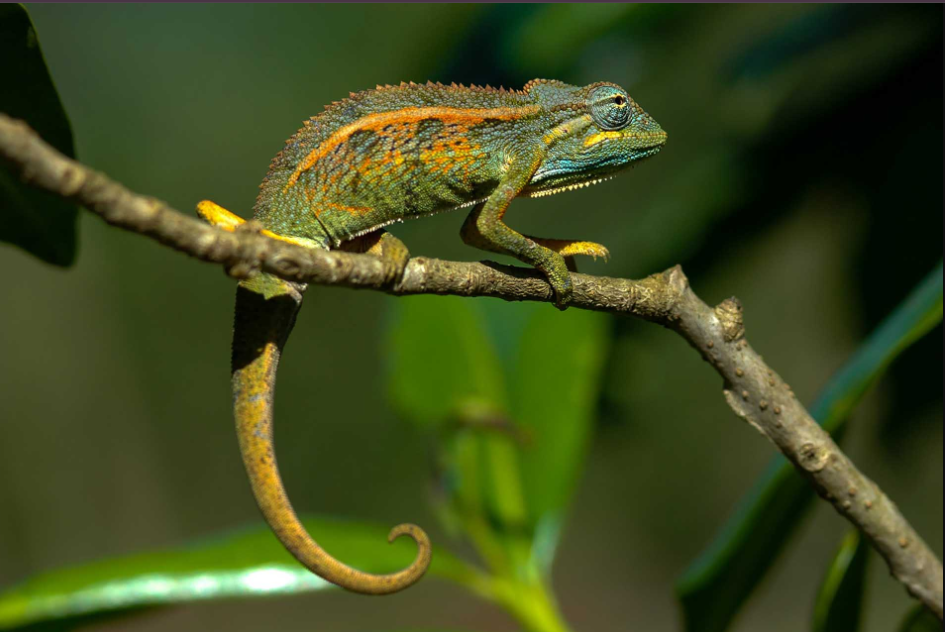
What You Didn’t Know About Chameleons
What You Didn’t Know About Chameleons: Chameleons (chamaeleons) from the family chamaeleonidae are surely unique and fascinating creatures which makes them extremely different from other species. They are mainly distinguished by their zygodactylous feet, compressed bodies, prehensile tails, swaying gait, strong eye coordination and unique projectile tongues that are used in sourcing for food.
Scientifically, they come from family-Chamaeleonidae, class-reptalia, Kingdom-Animalia, and order-squamata are reptile and mainly found in Africa in countries such as Uganda, Tanzania, Togo, Madagascar, among others.
A chameleon is unable to change to human color because its color changing mechanism is designed for temperature regulation, blending into natural environments and communication as well.
Chameleon Species
Some of the chameleon species include Some of the most common chameleons include Jackson’s chameleon (Trioceros jacksonii), Senegal chameleon (Chamaeleo senegalensis), Yemen or veiled chameleon (Chamaeleo calyptratus), the panther chameleon (Furcifer pardalis),and Other chameleons seen in captivity include Parson’s chameleon (Calumma parsonii),leaf-tailed chameleons, carpet chameleon (Furcifer lateralis), Meller’s chameleon (Trioceros melleri), three horned chameleon, carpenters chameleon, flap naked chameleons, strange horned chameleon, side striped chameleon, pygmy chameleon and several others species.
Habitat
What You Didn’t Know About Chameleons: Chameleons thrive best in continents such as Africa, parts of Asia and southern Europe however, they have also been introduced to places like Hawaii, Florida and California among others.
Chameleons lack a cellular mechanism to replicate specific skin tones of humans, remember their colors are produced by rearranging crystals called iridophores that reflect different wavelengths of light, primarily producing yellow, green, blue, and red.
The difference between the males and the females of the three horned chameleon is that the males have horns and females have no horns. There size also matters, the males, mature ones grow between 28 cm to30 cm and females always grow up to between 18- 20 centimetres (10 inches).
Most of these chameleons live a solitary life and they only mate during the time of mating. Their gestation period of the species is between 5 to 6 months with a life span of 5 years.
Male chameleons are more colourful and often have larger crests or horns than females. The smallest species of a chameleon is the Brookesia mica chameleon, which only grow not exceeding 3cm.
Chameleons live in high altitude areas above 1700 meters and are endemic in the Albertine Rift such as Mgahinga National Park, Bwindi National Park, Rwanda and Democratic Republic of Congo among others.
The specialized iridophore cells contain nano-crystals that act like tiny mirrors, changing the spacing between them to reflect light differently.
Changing colour
What You Didn’t Know About Chameleons: Chameleons change to darker colors to absorb heat and lighter colors to reflect heat.
Chameleons change colors not to perfectly camouflage into artificial backgrounds but rather to express their mood like mating, stress and dominance.
In conclusion, Chameleon color change is largely an involuntary reflex controlled by the automatic nervous system, not a conscious choice to match a specific object.
Unlike other chameleons which do lay eggs, some chameleon species such as the three horned chameleons produce young ones about 8-15 babies. Most species of chameleons lay eggs in holes they usually dig in the ground. However, some species though give birth to live young.