Discover the Peregrine Falcon
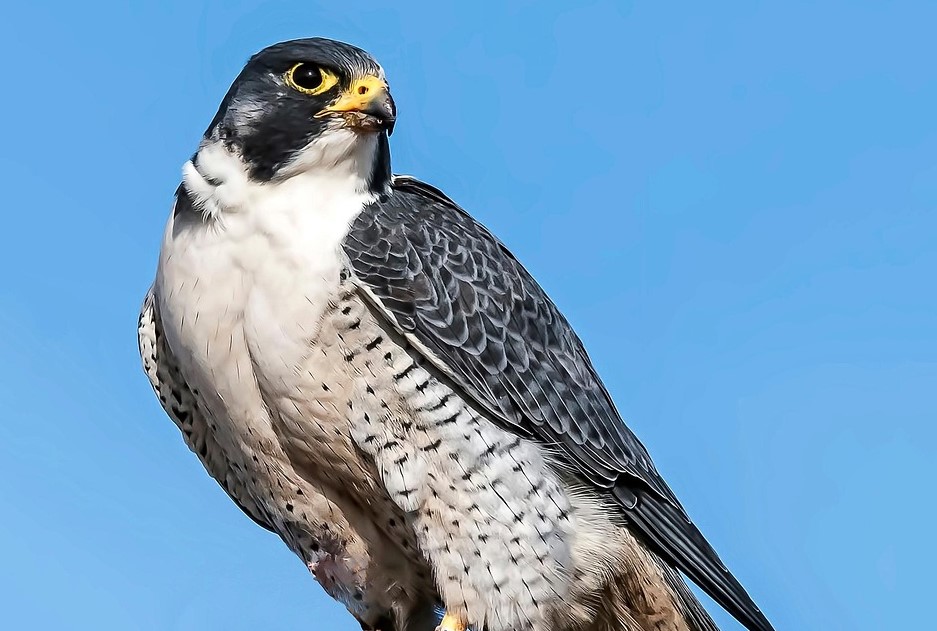
Discover the Peregrine Falcon: This striking peregrine falcon (Falco peregrinus) from the Falconidae family is a distinctive, powerful, and stunning bird of prey, remarkable as the fastest bird or creature on planet earth. This bird commands respect all over the world due to its prowess and distinctive hunting ability; it is skillful and versatile, with speed like a shooting star.
This speed hunter is known for its incredible hunting stoop (diving ability), meaning it can reach speeds exceeding 200 miles per hour (320 km/hr), an achievement of aerial skill that makes it a true wonder of the natural world.
Its speed is supported by its sleek and aerodynamic, muscular, streamline-lined body; long, pointed primary wings; and a distinctive, carved, or notched narrow tail that provides exceptional mobility, vital to control the tempo at high velocity.
Mature Peregrine Falcons are vibrant in appearance, possessing a blue-grey back, barred white underpants, and a distinctive black “hood” and malar stripe (moustache) that differs greatly from its white cheeks and throat.
This dark helmet is believed to reduce its angry stare (glare), which supports its vision when hunting its prey. They have an extraordinary vision, estimated to be eight times more powerful than that of humans, allowing them to spot potential prey from about 3 kilometers away.
Their diet primarily comprises, and is almost exclusive of, other bird species, from small birds to large pigeons, ducks, and others, which they tend to strike in mid-air with a clenched or curved foot, with an instant killing of their prey with the impact or with a precise bite to the neck.
Due to their larger numbers in terms of population than other bird species, especially in cities and towns, pigeons, specifically feral pigeons, enrich the diet of many peregrine populations as their ideal food source, especially in urban areas.
This is so far the world’s most widely spread raptor, covering a larger geographical area across the world. It always inhabits several parts of the world, especially land regions such as the Arctic tundra and the tropics, except extreme polar regions, tropical rainforests, and very high mountains.
These peregrine falcons exhibit remarkable adaptability in their selection and choice of nesting sites, commonly referred to as eyries. These bird species are natural cliff dwellers but have consistently adapted to urban environments, utilizing raised cliffs, bridges, tall trees, church spires, and tall skyscrapers as artificial cliffs. These structures stimulate their abundant source of pigeon prey and other birds.
They are monogamous, often mating for life and returning to the same nesting territory year after year.
Discover the Peregrine Falcon: Historically, research reveals that the peregrine falcon populations registered a catastrophic decline during the mid-20th century due to the widespread use of pesticides, specifically Dichlorodiphenyltrichloroethane (DDT), which led to thinning of their eggshells and reproductive failure, among others, leading to its declaration as one of an endangered species.
After thorough research, dichlorodiphenyltrichloroethane (DDT) pesticides were banned. Following the ban of DDT and through intensive captive breeding and reintroduction programs across its distribution range in the United States of America, this elusive and unique species made a striking recovery.
After normalising the situation, this striking bird species was removed from the endangered list of the (U.S. Endangered Species) in 1999 and is now a celebrated global conservation success story, thriving on every continent except Antarctica.